

The backend your multiplayer game needs.
Player auth, persistent data, leaderboards, server registry, live config, economy, and matchmaking - one platform for Unity, Roblox, Godot, and custom game servers.
Stop stitching together auth, player storage, leaderboard logic, server discovery, and runtime config. Wire up one API and keep shipping gameplay.
Free forever on the Dev plan. No credit card required.
$ curl -X POST https://api.gsb.dev/v1/leaderboards/global/scores \
  -H "Authorization: Bearer $GSB_KEY" \
  -d '{"player_id": "p_42", "score": 9001}'

HTTP/1.1 200 OK
{
  "rank": 7,
  "score": 9001,
  "board": "global"
}
import { GSBClient } from "@supercraft/gsb";
const gsb = GSBClient.forPlayer(
"https://api.gsb.dev", "proj_...", "env_...", process.env.GSB_KEY,
);
const auth = await gsb.loginAnonymous();
await gsb.submitScore("global", auth.player_id, 9001);
const top = await gsb.getTop("global", 10);
console.log(`#${top[0].rank} ${top[0].player_id}`);using Supercraft.GSB;
var gsb = GSBClient.ForPlayer(
"https://api.gsb.dev", "proj_...", "env_...", apiKey);
var auth = await gsb.LoginAnonymousAsync();
await gsb.SubmitScoreAsync("global", auth.player_id, 9001);
var top = await gsb.GetTopAsync("global", 10);
Debug.Log($"#{top[0].rank} {top[0].player_id}");# Autoload GSB once via Project Settings → Autoload
GSB.init_player("https://api.gsb.dev", "proj_...", "env_...", api_key)
var auth = await GSB.login_anonymous()
await GSB.submit_score("global", auth.player_id, 9001.0)
var top = await GSB.get_top("global", 10)
print("#%d %s" % [top[0].rank, top[0].player_id])-- Server Script in ServerScriptService
local GSB = require(game.ServerScriptService.GSB)
local gsb = GSB.init("proj_...", "YOUR_SERVER_TOKEN", "env_...")
game.Players.PlayerAdded:Connect(function(player)
local record = gsb:VerifyPlayer(player.UserId)
gsb:SubmitScore("global", record.player_id, 9001)
local top = gsb:GetLeaderboardTop("global", 10)
print(string.format("#%d %s", top[1].rank, top[1].player_id))
end)Most backend tools handle players. Most hosting tools handle servers.
GSB brings both together, so the runtime needs of multiplayer games stop living across custom scripts, ad hoc endpoints, and operational guesswork. One platform to authenticate players, store progression and shared game state, run leaderboards and seasonal resets, register and discover dedicated servers, deliver live configs, and keep staging and production separate.
Built for live games, not generic apps
Configs, player state, rankings, and server availability stay connected instead of drifting apart across five different tools.
Covers the runtime side too
Not just auth plus a database. Dedicated-server registration, discovery, live config, and matchmaking - the surfaces multiplayer games actually need.
Fewer platforms to stitch
Move faster without assembling separate vendors for auth, persistence, rankings, config rollout, and server discovery.
Cleaner rollout to production
Go from prototype to live without the backend becoming the part slowing down shipping. Environment-aware by design.
What you get
Enough breadth to run live operations, without dragging in a giant platform you do not need. Every feature is on every plan.
Player Authentication
Email and password, guest sessions, OAuth (Google, GitHub, Discord), and Roblox verification. Support real accounts, onboarding, and authenticated player access without building auth from scratch.
Persistent Player Data
Player-scoped and project-scoped JSON documents for progression, profiles, unlocks, event flags, inventories, and shared runtime values. Server-authoritative with patch semantics.
Leaderboards
Ranked and seasonal boards with configurable rules, fast ranking reads, recurring resets, and support for timed events or score-based loops. Anti-cheat friction on write.
Economy
Currencies, virtual items, and inventories with atomic updates for rewards, sinks, consumables, and grants. Every transaction audited server-side.
Dedicated Server Registry
Register, heartbeat, and search dedicated servers to power server browsers, active session discovery, region-aware listings, and stale cleanup.
Live Config Delivery
Upload versioned bundles and activate them per environment so balance changes, rotations, loot tables, and rulesets ship without a full patch.
Matchmaking
Tickets, rulesets, region-aware allocation, and admin tooling for forced forms and queue management. Wire it to your own servers or a reserved-server pool.
Social
Friends, pending requests, and blocks. Drop-in social graph so your players can connect without a third-party identity vendor.
Built to watch a live game, not a generic app.
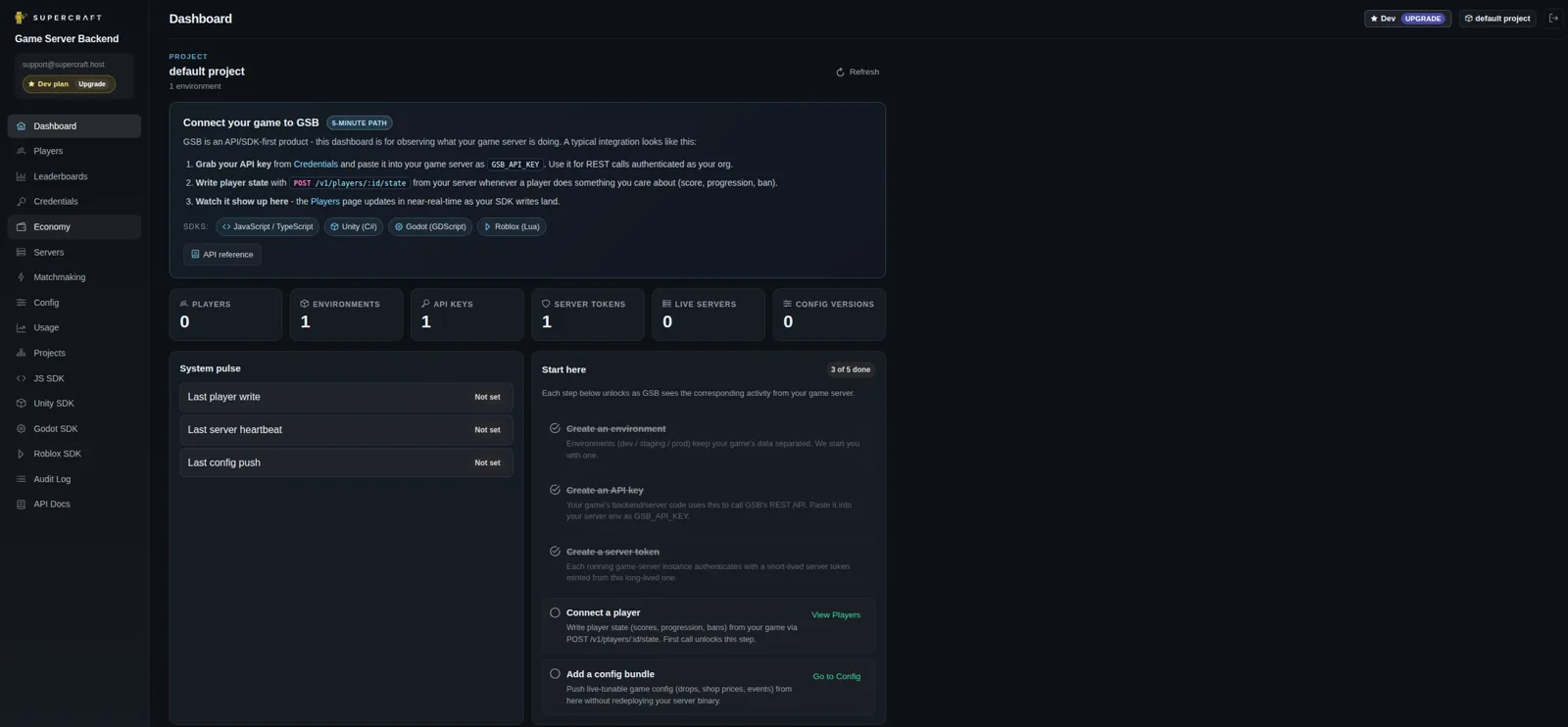
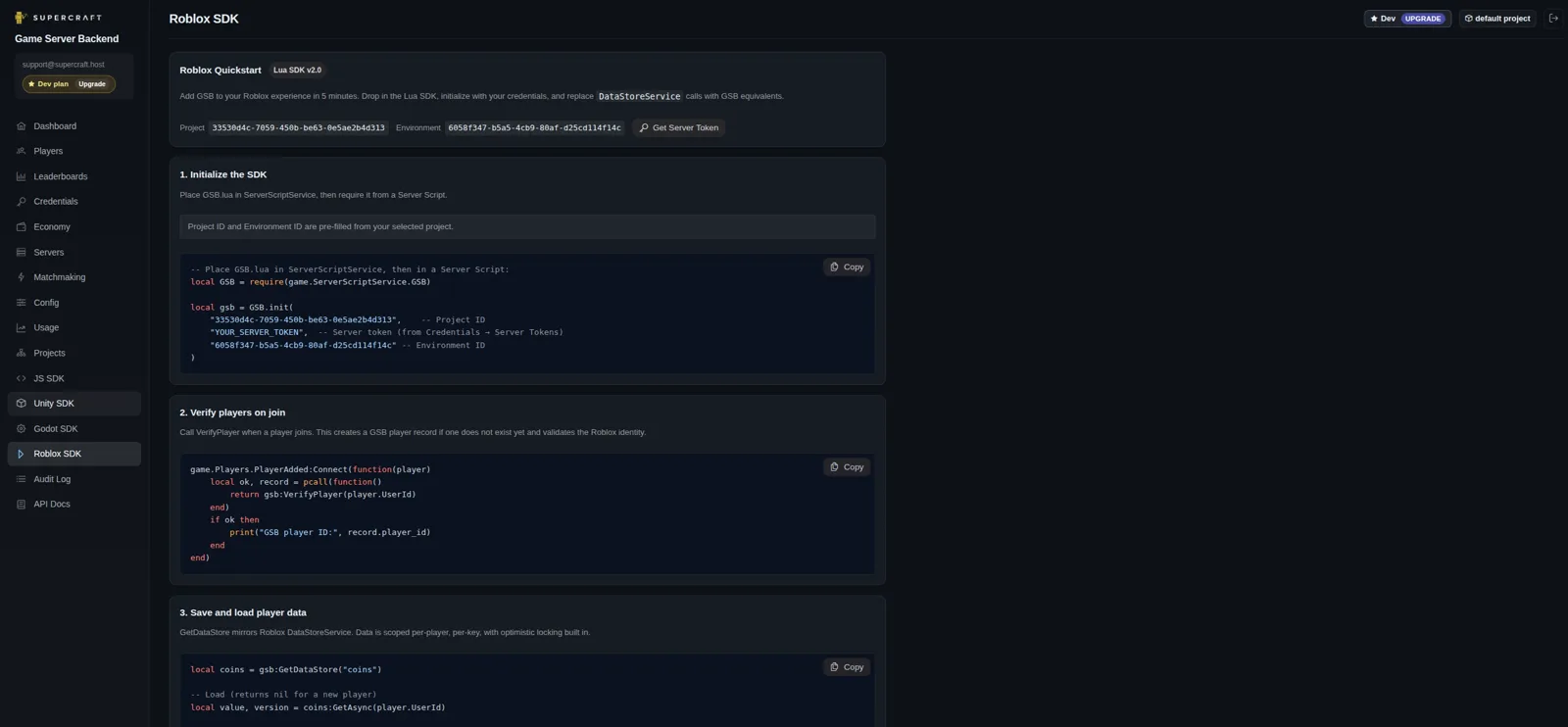
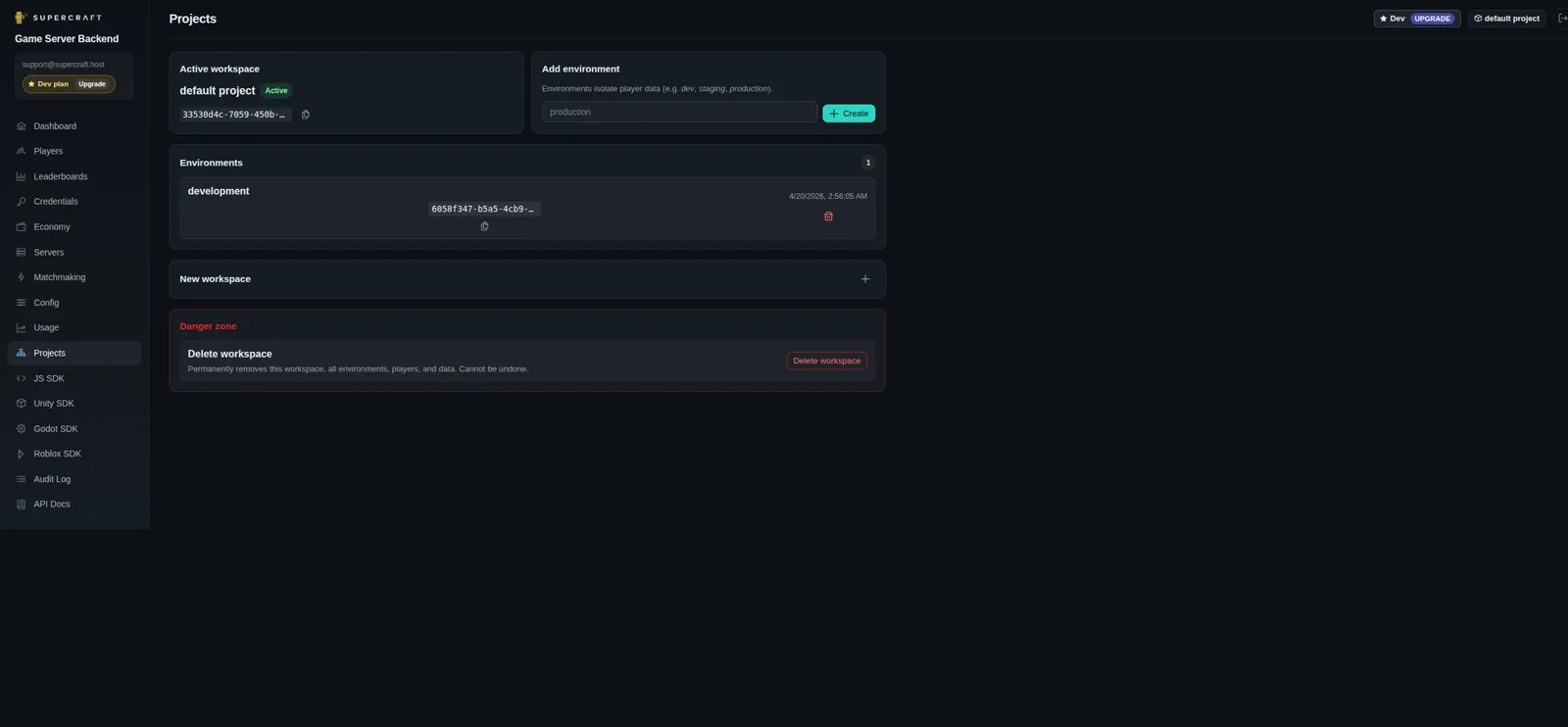
The dashboard observes your running game - player writes, server heartbeats, config pushes, and SDK quickstarts for every engine you ship on.
One API. Three auth modes.
API Key
Admin scripts, CI, tooling, and control-plane access.
Server Token
Dedicated game servers and trusted runtime services.
Player JWT
Authenticated players issued by the auth system.
Players, servers, and operators stay on separate trust boundaries while the surface area is simple enough to integrate with Unity, Roblox, Godot, or any HTTP client.
Example outcomes
- Player profiles and progression
- Guest-to-account upgrade flows
- Seasonal scoreboards and rank loops
- Server browser features
- Live event configuration
- Balance and loot tuning
- Server-authoritative reward systems
- Environment-aware staging and rollout
Built around multiplayer games, not generic app backends.
Most generic backends stop at auth and storage. GSB also covers the runtime needs of server-based games, with a better fit for live ops and environment-aware rollout.
Best suited for
- Dedicated-server games
- Multiplayer survival and co-op games
- Region-based game server fleets
- Unity, Roblox, Godot, and custom-engine backends
- Indie and mid-size studios that want backend velocity
- Teams that do not want to build a platform team before shipping gameplay
Less suited for
- Purely offline, single-player games
- Projects that only need a generic login database
- Highly specialized AAA matchmaking stacks from day one
Why say this clearly? Because the offer is stronger when it reads like a tool built for a specific class of multiplayer game, not a vague "backend for everything."
The stack you'd have built yourself.
Boring, proven components. No surprise vendor lock-in, no homegrown database engine.
| Component | Role |
|---|---|
| Go API server | Single binary API service |
| PostgreSQL | Primary data store with row-level security |
| Redis | Hot caches, rate limiting, matchmaking queues |
| Object storage | Versioned config bundle storage |
- Clean environment isolation. Production, staging, and test stay separated by design.
- Server-aware runtime APIs. Dedicated servers do not impersonate admin clients.
- Live-ops friendly. Configs, rankings, and player state fit together operationally.
- Stack-flexible. Use it with launchers, dashboards, custom tools, and game services.
Build the backend your multiplayer game actually needs.
Start on the free Dev tier - 2,000 MAU and 2M API calls per month. No credit card. Upgrade when your game takes off.